Ontario G1 Practice Mock Exam 4
All 20 questions from Mock Exam 4, with answers and explanations.
These are the 20 questions from Mock Exam 4, covering road signs and the rules of the road from the official MTO Driver’s Handbook. Read through them with Show answer, or take the exam online first with the answers hidden and see your score. No sign-in needed.
Question 1 · Alcohol & Drugs
What blood-alcohol level is allowed for a driver aged 21 or younger, whatever their licence class?
- A. .02%
- B. .05%
- C. Zero
- D. .08%
Show answer
Answer: C. Zero
Young drivers may have no alcohol in their system at all.
Question 2 · Traffic Signs
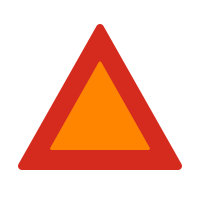
This orange triangle with a red border on the back of a vehicle means the vehicle:
- A. Moves at no more than 40 km/h
- B. Is carrying dangerous goods
- C. Is an emergency vehicle
- D. Is a school bus
Show answer
Answer: A. Moves at no more than 40 km/h
The orange triangle warns that the vehicle is slow and will not exceed 40 km/h.
Question 3 · Turning & Lane Changes
It is illegal to drive in reverse on a divided road with a speed limit of more than:
- A. 40 km/h
- B. 80 km/h
- C. 50 km/h
- D. 100 km/h
Show answer
Answer: B. 80 km/h
It is illegal to reverse on a divided road with a limit over 80 km/h.
Question 4 · G1 Licence Rules
Which two tests must you pass to be issued your first Ontario licence?
- A. A road test and a vision test
- B. A vision test and a knowledge test
- C. A knowledge test only
- D. A written test and a parking test
Show answer
Answer: B. A vision test and a knowledge test
You need to pass an eyesight screening and a written test on road rules and signs.
Question 5 · Seatbelts & Safety
How should the lower part of the seatbelt sit on your body?
- A. Across your belly
- B. Snug across the hip bones, below the stomach
- C. Across your chest
- D. In whatever position feels comfortable
Show answer
Answer: B. Snug across the hip bones, below the stomach
Worn across the hips, the belt loads strong bones rather than soft organs in a crash.
Question 6 · Seatbelts & Safety
Tires should not be older than:
- A. 10 years
- B. 3 years
- C. 5 years
- D. 15 years
Show answer
Answer: A. 10 years
Tires should not be older than 10 years.
Question 7 · Pavement Markings
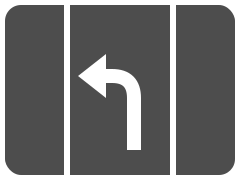
A white arrow painted in your lane tells you:
- A. You can go any direction
- B. You must stop
- C. You can overtake vehicles ahead
- D. You must travel only the way the arrow points
Show answer
Answer: D. You must travel only the way the arrow points
Lane arrows limit you to the direction shown.
Question 8 · Freeway Driving
If you miss your exit on a freeway, you should:
- A. Take the next exit
- B. Stop and reverse
- C. Make a U-turn
- D. Back up on the shoulder
Show answer
Answer: A. Take the next exit
Never stop or back up on a freeway; carry on to the following exit and find your way back from there.
Question 9 · Traffic Lights
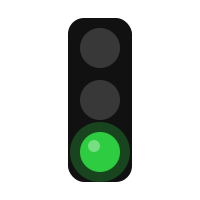
What does this signal mean?
- A. You have the right-of-way over everything in the intersection
- B. You must stop if any vehicle is waiting
- C. You may continue straight or turn left or right, once vehicles and pedestrians still in the intersection have cleared
- D. You may only go straight
Show answer
Answer: C. You may continue straight or turn left or right, once vehicles and pedestrians still in the intersection have cleared
A green light permits you to go, but anyone still in the intersection gets to finish first.
Question 10 · Sharing the Road
What is the penalty for failing to stop for a school bus on a first offence?
- A. A warning only
- B. A heavy fine and six demerit points
- C. One demerit point
- D. No demerit points
Show answer
Answer: B. A heavy fine and six demerit points
A first offence brings a large fine plus six demerit points on your record.
Question 11 · Emergencies
If your headlights fail while driving at night, you should:
- A. Keep driving slowly
- B. Use parking lights only
- C. Try the headlight switch, then put on your hazards and pull safely off the road
- D. Follow a vehicle ahead
Show answer
Answer: C. Try the headlight switch, then put on your hazards and pull safely off the road
Make one quick check of the switch; if lights stay off, signal with hazards and stop well clear of traffic.
Question 12 · Speed & Following Distance
What does it mean to drive faster than your headlights allow at night?
- A. Using high beams in town
- B. Having grimy headlights
- C. Needing more road to stop than your lights illuminate
- D. Driving with one headlight out
Show answer
Answer: C. Needing more road to stop than your lights illuminate
If it takes longer to stop than the distance your lights reveal, you cannot react to hazards in time.
Question 13 · Right-of-Way
Two cars arrive together at an all-way stop. Which one has priority?
- A. The car on the other's right side
- B. The car on the other's left side
- C. The car turning left
- D. The car that signalled first
Show answer
Answer: A. The car on the other's right side
When arrival is simultaneous, the driver with the other car to their right waits.
Question 14 · Parking
How much room do you need to parallel park comfortably?
- A. As long as your vehicle
- B. Double the length plus the width of your vehicle
- C. Roughly your length with half as much again
- D. Any gap your bumper fits into
Show answer
Answer: C. Roughly your length with half as much again
Aim for a space around 1.5 times your vehicle length so you can manoeuvre in.
Question 15 · Turning & Lane Changes
How close to a bridge, viaduct or tunnel may you no longer cross the centre line to pass?
- A. 5 metres
- B. 10 metres
- C. 100 metres
- D. 30 metres
Show answer
Answer: D. 30 metres
Overtaking over the centre line is off-limits in the 30 metres approaching these structures.
Question 16 · Speed & Following Distance
You need to leave extra space around your vehicle when:
- A. Driving on a dry, empty road
- B. Driving slowly in a parking lot
- C. Driving with the windows open
- D. Weather is poor, you are behind a motorcycle or big truck, or you are heavily loaded
Show answer
Answer: D. Weather is poor, you are behind a motorcycle or big truck, or you are heavily loaded
Those situations make stopping harder or riskier, so give yourself a bigger cushion.
Question 17 · Traffic Signs
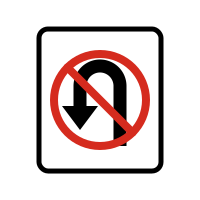
What does this sign mean?
- A. No left turns
- B. No right turns
- C. U-turns permitted when the road is clear
- D. Do not turn to go in the opposite direction
Show answer
Answer: D. Do not turn to go in the opposite direction
This sign prohibits turning around to head back the way you came.
Question 18 · Night & Weather Driving
When roads are snowy or the weather is bad, what should you do with cruise control?
- A. Use it to hold a steady speed
- B. Use it on freeways only
- C. Set it at the speed limit
- D. Leave it off
Show answer
Answer: D. Leave it off
Cruise control can make a slide worse, so drive manually when traction is poor.
Question 19 · G1 Licence Rules
Is it ever acceptable to let someone else borrow your licence?
- A. No, never
- B. Yes, a relative
- C. Yes, for up to a day
- D. Yes, if they are riding with you
Show answer
Answer: A. No, never
A licence belongs to the person it was issued to and may not be loaned to anyone.
Question 20 · Traffic Signs
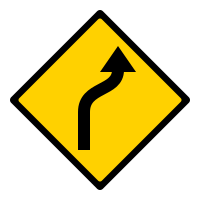
What do warning signs like this one usually look like?
- A. Octagons with red fill
- B. Yellow diamonds with black symbols or lettering
- C. Green rectangles
- D. Blue circles
Show answer
Answer: B. Yellow diamonds with black symbols or lettering
Yellow diamond signs with black markings alert you to hazards ahead.
Ready for the real thing?
Practise with full 20-question mock exams that are scored like test day, with explanations for every answer and stats that show what to study next.