Ontario G1 Practice Mock Exam 3
All 20 questions from Mock Exam 3, with answers and explanations.
These are the 20 questions from Mock Exam 3, covering road signs and the rules of the road from the official MTO Driver’s Handbook. Read through them with Show answer, or take the exam online first with the answers hidden and see your score. No sign-in needed.
Question 1 · Traffic Signs
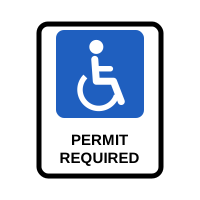
Who may use a parking space marked with this sign?
- A. Only vehicles with a current accessible parking permit on display
- B. Anyone parking for under 15 minutes
- C. Any vehicle with its hazard lights on
- D. Delivery vehicles only
Show answer
Answer: A. Only vehicles with a current accessible parking permit on display
Such spaces are reserved for vehicles showing a current Accessible Parking Permit.
Question 2 · G1 Licence Rules
A G2 driver aged 19 or under has held the licence for more than six months. Between midnight and 5 a.m., how many passengers aged 19 or under may they carry?
- A. Two
- B. Four
- C. Five
- D. Three
Show answer
Answer: D. Three
Once six months have passed, as many as three young passengers (19 or under) are allowed.
Question 3 · Speed & Following Distance
You are outside a city, town or village and no speed limit sign is posted. What is the top legal speed?
- A. 80 km/h
- B. 50 km/h
- C. 60 km/h
- D. 100 km/h
Show answer
Answer: A. 80 km/h
The default limit outside built-up municipalities is 80 km/h.
Question 4 · Traffic Signs
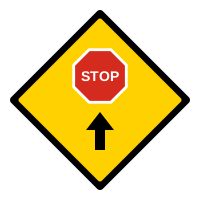
What does this sign mean?
- A. You must stop here
- B. A traffic light is ahead
- C. The road ends ahead
- D. Prepare to stop; a stop sign is coming up
Show answer
Answer: D. Prepare to stop; a stop sign is coming up
This is an advance warning of a stop sign, so reduce speed in good time.
Question 5 · Seatbelts & Safety
When seated properly, how far ahead of your vehicle should the road surface be visible?
- A. One metre in front
- B. Ten metres in front
- C. Four metres in front of the vehicle
- D. Fifty metres in front
Show answer
Answer: C. Four metres in front of the vehicle
Adjust your seat height so you can see the pavement about four metres ahead of the vehicle.
Question 6 · Night & Weather Driving
You must use low-beam headlights within what distance of an oncoming vehicle?
- A. 15 metres
- B. 150 metres
- C. 50 metres
- D. 500 metres
Show answer
Answer: B. 150 metres
Use low-beam headlights within 150 metres of an oncoming vehicle.
Question 7 · Sharing the Road
If you see an animal on the road, you should:
- A. Speed up to pass
- B. Slow down and sound your horn; do not drive around it
- C. Drive around it quickly
- D. Stop and get out
Show answer
Answer: B. Slow down and sound your horn; do not drive around it
Slow down and sound your horn; animal movements are unpredictable.
Question 8 · G1 Licence Rules
How much driving experience must the licensed driver who supervises a G1 driver have?
- A. At least one year
- B. At least two years
- C. At least ten years
- D. At least four years
Show answer
Answer: D. At least four years
The supervising driver needs a minimum of four years behind the wheel.
Question 9 · Pavement Markings
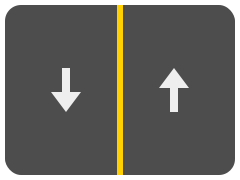
What does the yellow line in this picture divide?
- A. Vehicles heading the same way
- B. Vehicles heading in opposite directions
- C. Bike lanes from vehicle lanes
- D. Parking from driving lanes
Show answer
Answer: B. Vehicles heading in opposite directions
A yellow line divides lanes of vehicles that are moving toward each other.
Question 10 · Traffic Signs
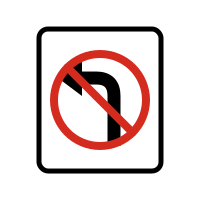
What does this sign mean?
- A. Turn left only when it is clear
- B. Left turns are prohibited here
- C. Left turns allowed at night only
- D. Left lane must turn left
Show answer
Answer: B. Left turns are prohibited here
This sign prohibits turning left.
Question 11 · Right-of-Way
How should you apply the brakes?
- A. Pump the pedal quickly
- B. Slam the pedal hard
- C. Press the brake pedal firmly and evenly
- D. Apply pressure in short bursts
Show answer
Answer: C. Press the brake pedal firmly and evenly
Press the brake pedal firmly and evenly.
Question 12 · Traffic Lights
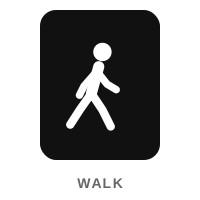
A pedestrian facing this signal:
- A. Must wait for vehicles to clear
- B. Should only cross at a crossover
- C. May cross, and vehicles must yield to them until they reach the other side
- D. May cross only if no vehicles are turning
Show answer
Answer: C. May cross, and vehicles must yield to them until they reach the other side
Someone on foot who is crossing on this signal takes priority over every vehicle until they are across.
Question 13 · Alcohol & Drugs
Which of these is prohibited under Ontario's street racing and stunt driving rules?
- A. Driving 10 km/h over the posted limit
- B. Driving 50 km/h or more above the posted speed limit
- C. Driving in the right-hand lane
- D. Signalling a lane change early
Show answer
Answer: B. Driving 50 km/h or more above the posted speed limit
Driving 50 km/h or more over the posted limit is a stunt driving offence.
Question 14 · Turning & Lane Changes
It is illegal to make a U-turn:
- A. Where bends, rises, railway tracks, bridges or tunnels limit how far you can see
- B. On a straight road with good visibility
- C. In a residential area only
- D. At a stop sign only
Show answer
Answer: A. Where bends, rises, railway tracks, bridges or tunnels limit how far you can see
U-turns are banned in places where your view of oncoming traffic is restricted, such as bends, hill crests, near rail crossings, and by bridges or tunnels.
Question 15 · Seatbelts & Safety
When the interior mirror is set correctly, what should you see in it?
- A. The side window
- B. The back seat
- C. The rear window, framed evenly in the middle of the mirror
- D. The road ahead
Show answer
Answer: C. The rear window, framed evenly in the middle of the mirror
Aim the mirror so the rear window sits squarely in the middle of it, giving the best view behind you.
Question 16 · Parking
You park facing downhill next to a curb. Which way should the front wheels point?
- A. Away from the curb
- B. Straight ahead
- C. Out toward the road
- D. Toward the curb (or the right edge of the road if there is no curb)
Show answer
Answer: D. Toward the curb (or the right edge of the road if there is no curb)
Pointing the wheels at the curb means a rolling vehicle will be stopped by it.
Question 17 · Demerit Points & Suspensions
After a fully licensed driver's suspension for demerit points ends, their points are reduced to:
- A. Seven
- B. Zero
- C. Five
- D. Nine
Show answer
Answer: A. Seven
Once a fully licensed driver has served the demerit suspension, their record is set back to seven points.
Question 18 · Speed & Following Distance
In good driving conditions, what is the smallest safe gap to leave between you and the vehicle ahead?
- A. A one-second gap
- B. A half-second gap
- C. A two-second gap
- D. Five car lengths at any speed
Show answer
Answer: C. A two-second gap
A gap of two seconds is the minimum; increase it when conditions get worse.
Question 19 · Traffic Signs
A lane-use sign tells you that:
- A. Certain lanes are reserved for particular kinds of vehicle, either permanently or at set times
- B. All lanes are open to all vehicles
- C. The lane ends ahead
- D. Speed is restricted in the lane
Show answer
Answer: A. Certain lanes are reserved for particular kinds of vehicle, either permanently or at set times
These signs reserve a lane for particular vehicles, for example buses or bikes, always or only at stated times.
Question 20 · Freeway Driving
You are leaving a freeway. When should you start reducing speed?
- A. While still in the freeway lane, before entering the exit lane
- B. Only once you pass the line
- C. Only if there is traffic
- D. After you have moved into the exit lane
Show answer
Answer: D. After you have moved into the exit lane
Signal early, steer into the exit lane at freeway speed, and brake there so traffic behind is not surprised.
Ready for the real thing?
Practise with full 20-question mock exams that are scored like test day, with explanations for every answer and stats that show what to study next.