Ontario G1 Practice Mock Exam 1
All 20 questions from Mock Exam 1, with answers and explanations.
These are the 20 questions from Mock Exam 1, covering road signs and the rules of the road from the official MTO Driver’s Handbook. Read through them with Show answer, or take the exam online first with the answers hidden and see your score. No sign-in needed.
Question 1 · Traffic Signs

You approach this sign at an intersection. What must you do?
- A. Slow down and continue
- B. Come to a complete stop
- C. Stop only if another vehicle is approaching
- D. Honk and proceed
Show answer
Answer: B. Come to a complete stop
A stop sign requires you to come to a complete stop.
Question 2 · Traffic Signs
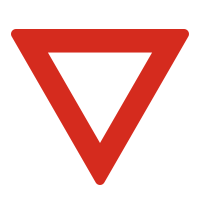
What does this sign require you to do?
- A. Always come to a complete stop
- B. Speed up before entering the intersection
- C. Give way to other vehicles, stopping only if you need to
- D. Proceed without checking for traffic
Show answer
Answer: C. Give way to other vehicles, stopping only if you need to
A yield sign tells you to give way to others. You only stop when that is needed to let them through.
Question 3 · Railway Crossings
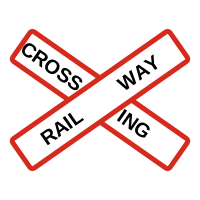
What should you do when approaching this sign?
- A. Speed up to cross quickly
- B. Reduce speed, check in both directions and be ready to stop
- C. Stop only if you can see a train
- D. Pass any vehicle that has stopped
Show answer
Answer: B. Reduce speed, check in both directions and be ready to stop
Near a railway crossing, ease off, check both ways for trains and be ready to stop.
Question 4 · Traffic Signs
What does a red circle with a diagonal line through a symbol generally mean?
- A. The action is required
- B. The action is recommended
- C. That behaviour is prohibited
- D. The sign applies only at night
Show answer
Answer: C. That behaviour is prohibited
A red circle crossed by a slash usually prohibits whatever the symbol depicts.
Question 5 · Safe Driving
What is an important principle of defensive driving?
- A. Follow other vehicles closely
- B. Focus only on the vehicle directly ahead
- C. See well, keep room around you and let others know your intentions
- D. Assume other drivers will always obey the rules
Show answer
Answer: C. See well, keep room around you and let others know your intentions
Safe defensive driving rests on good visibility, free room around your vehicle and clear signals to others, while watching for hazards.
Question 6 · Safe Driving
How can you help keep a safe buffer around your vehicle?
- A. Follow the vehicle ahead closely
- B. Keep a margin of free room on all sides of your vehicle
- C. Drive beside another vehicle whenever possible
- D. Use the shoulder when traffic slows
Show answer
Answer: B. Keep a margin of free room on all sides of your vehicle
Free room around your vehicle buys you extra time and room to react to hazards.
Question 7 · Pedestrians
What should you do when approaching a pedestrian crossover?
- A. Continue if you do not see another vehicle
- B. Stop and yield to pedestrians
- C. Honk to warn pedestrians
- D. Pass another vehicle that has stopped
Show answer
Answer: B. Stop and yield to pedestrians
Drivers must stop and yield to pedestrians at a pedestrian crossover.
Question 8 · Traffic Lights
What does a solid red traffic light require you to do?
- A. Stop
- B. Proceed if there is no traffic
- C. Speed up before the light changes
- D. Proceed if another driver signals you
Show answer
Answer: A. Stop
A solid red traffic light requires you to stop.
Question 9 · Safe Driving
Why should you continually scan the road and check your surroundings while driving?
- A. To avoid using your mirrors
- B. To identify hazards early and give yourself time to respond
- C. To determine the speed of vehicles behind you
- D. To reduce the need to signal
Show answer
Answer: B. To identify hazards early and give yourself time to respond
Continually scanning helps you identify hazards early and gives you more time to react.
Question 10 · Traffic Signs
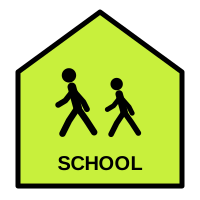
What does this sign warn drivers about?
- A. A mandatory stop at every school
- B. A railway crossing
- C. A school zone where extra caution is required
- D. A road reserved for school buses
Show answer
Answer: C. A school zone where extra caution is required
A school-zone sign warns drivers that they are entering a school zone and should slow down and use extra caution.
Question 11 · G1 Licence Rules
What is the minimum amount of time you must hold a Level Two (G2) licence?
- A. 6 months
- B. 8 months
- C. 24 months
- D. 12 months
Show answer
Answer: D. 12 months
Level Two lasts a minimum of 12 months.
Question 12 · Pavement Markings
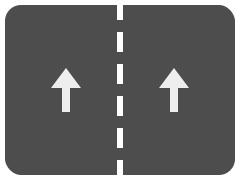
What does the white line in this picture divide?
- A. Vehicles heading in opposite directions
- B. Vehicles heading the same way
- C. Roads from sidewalks only
- D. School zones from other areas
Show answer
Answer: B. Vehicles heading the same way
A white line divides lanes of vehicles that are moving the same way.
Question 13 · G1 Licence Rules
Without completing an approved driver education course, how long is the Level One (G1) period?
- A. 12 months
- B. 6 months
- C. 8 months
- D. 18 months
Show answer
Answer: A. 12 months
The G1 period is 12 months. Completing an approved course shortens it to 8 months.
Question 14 · Right-of-Way
Two vehicles arrive from different roads at the same moment at an intersection with no signs or signals. Which goes first?
- A. The vehicle on the left
- B. The vehicle on the right
- C. The larger vehicle
- D. The faster vehicle
Show answer
Answer: B. The vehicle on the right
Yield to the vehicle approaching from your right.
Question 15 · Night & Weather Driving
Your car starts sliding on a slippery road. What is the best first thing to do?
- A. Stomp on the brake pedal
- B. Point the wheels away from where the car is sliding
- C. Look and steer toward where you want the car to end up
- D. Press harder on the accelerator
Show answer
Answer: C. Look and steer toward where you want the car to end up
Aim the front wheels toward the path you want the car to follow.
Question 16 · Freeway Driving
Which action by a slower vehicle on a freeway is both unsafe and against the law?
- A. Driving in the right lane
- B. Using the shoulder
- C. Signalling early
- D. Pulling in sharply ahead of a faster vehicle
Show answer
Answer: D. Pulling in sharply ahead of a faster vehicle
Pulling in sharply in front of faster traffic is unsafe and illegal.
Question 17 · Alcohol & Drugs
A driver aged 21 or under who has any alcohol in their system receives an immediate:
- A. 24-hour roadside suspension
- B. Verbal warning only
- C. 7-day licence suspension
- D. Fine with no suspension
Show answer
Answer: A. 24-hour roadside suspension
A 24-hour roadside suspension applies immediately, with a minimum 30-day suspension on conviction.
Question 18 · Seatbelts & Safety
How should your head restraint be set?
- A. So your head is below the restraint
- B. So your head is above the restraint
- C. So the middle of the restraint lines up with the back of your head
- D. As low as it will go
Show answer
Answer: C. So the middle of the restraint lines up with the back of your head
Set the restraint so its centre is level with the rear of your head.
Question 19 · Parking
How close to a fire hydrant is parking prohibited?
- A. Three metres
- B. One metre
- C. Five metres
- D. Ten metres
Show answer
Answer: A. Three metres
Keep your vehicle at least three metres away from a hydrant.
Question 20 · Demerit Points & Suspensions
How long do demerit points count against your record?
- A. One year after the offence
- B. Two years after the offence
- C. Five years after the offence
- D. Until your licence is renewed
Show answer
Answer: B. Two years after the offence
Points remain for two years, counted from the day of the offence.
Ready for the real thing?
Practise with full 20-question mock exams that are scored like test day, with explanations for every answer and stats that show what to study next.