
Brain and Senses: how the challenges work
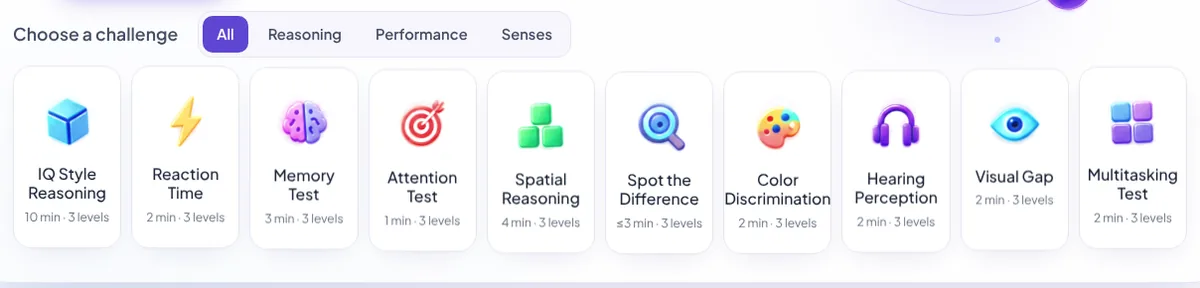
Brain and Senses, at chowchowlabs.com, is a set of ten short challenges for reasoning, memory, attention, reaction time, colour, hearing and vision. Each takes a few minutes, has three levels, and tells you exactly how it’s scored. This page explains what they are, how they’re designed, and what they are not.
The ten challenges
| Challenge | What you do | Time |
|---|---|---|
| IQ style reasoning | Find the shape that completes a pattern in a row or grid | About 10 min |
| Reaction time | Respond the moment a panel lights up | About 2 min |
| Memory | Repeat sequences of growing length | About 3 min |
| Attention | Respond to target symbols and ignore the rest | About 1 min |
| Spatial reasoning | Pick the correctly rotated shape | About 4 min |
| Spot the difference | Find every change between two scenes | Up to 3 min |
| Colour discrimination | Identify shapes set apart by subtle colour differences | About 2 min |
| Hearing perception | Pick which of three sounds was different | About 2 min |
| Visual gap | Spot which way a gap in a ring points as it shrinks | About 2 min |
| Multitasking | Do a symbol task while remembering a position | About 2 min |
Each challenge has Entry, Regular and Hard levels, so you can start easy and come back for something harder.
Scoring you can check
Most online “brain tests” give you a single impressive-sounding number with no explanation. We do the opposite: every challenge publishes its scoring rule on its own page, in plain language. A few examples:
- Reaction time is the median of ten valid responses, not the average, so one slow tap doesn’t ruin your result. Responding before the cue is a false start, and times under 100 ms or over 2 seconds are thrown out.
- Attention uses balanced accuracy: the average of how many targets you caught and how many non-targets you correctly ignored. Tapping everything doesn’t score well.
- Hearing perception reports a raw count of correct answers, and tells you that guessing alone would get about one in three right.
- IQ style reasoning counts correct puzzles, with no penalty for wrong answers, and deliberately doesn’t convert your score into an IQ number.
What these challenges are not
They’re for fun, practice and curiosity. They aren’t medical, psychological or diagnostic tests. The colour challenge doesn’t diagnose colour blindness, the hearing challenge doesn’t give a hearing level, and the visual gap challenge isn’t an eye exam or a prescription. Results also depend on your device: screen size, brightness, speakers or headphones, and the delay in your browser all affect them. If you have a concern about your vision, hearing or memory, see a professional.
Accessibility
Each challenge page lists what it needs, such as seeing shapes or hearing tones, and says honestly when a challenge can’t yet be completed with a screen reader. The site works with mouse, touch or keyboard on any screen at least 320 pixels wide.
What’s free
All ten challenges and their basic results are free, without an account. Optional Premium adds detailed breakdowns, item review and trends over time, and removes ads. The site is available in English, French, Japanese, and Simplified and Traditional Chinese.
Try it
Open Brain and Senses or get the iPhone app.
Sources
- ChowChow Labs, Brain and Senses methodology and scoring rules